
noisy writing

Yes, I know I said I wasn’t going to post on here for a while. But then I was reading this great book and a section of it jumped out at me and I wanted to share it. It’s a book called Story of a Poem by Matthew Zapruder, where he basically brings the reader along with him as he writes draft after draft of one poem. I love learning about his creative process, his explanation of what specific lines mean, and above all, the doubt about his own abilities and even doubts about the importance of poetry itself. He also wrote a big ol’ book called Why Poetry that I attempted to read a while back but found kind of tedious. This book is extremely vulnerable and honest and full of stunning gems about writing poetry. If it wasn’t a library book I would be underlining all over the place.
So here’s a part that jumped out at me:
“In that little room overlooking School Street, surrounded by snow, I began to type each version of whatever poem I was writing, over and over again, on the Royal Quiet Deluxe, not quiet at all. Each time when I was done I would yank the poem dramatically out of the platen and stare at it, maybe making some marks. If I wanted to see what the change would look like, I’d have to retype, even if it was just a single word. The process was slow, meditative, hypnotic. I could work for many hours like this. The sound of a typewriter is unmistakable. It resonates in a room, timelessly, through doors, into the world. The sounds entirely dominated my skull. I began not to think about but to hear how necessary each word was or wasn’t; if I could skip something to avoid typing it for the fiftieth or hundredth time, and then when I read it, it sounded fine, I would never look back.
“The poems changed, becoming more focused. There are at least fifty, and sometimes several hundred, typewritten versions of each of those poems in a box somewhere. … I started to see the possibilities of a simple, clear narrative that allowed for both worldly and dreamlike events. I wrote that way for a while, imagining a reader, and being as deliberate as possible. I was also writing for myself, to find out what I had to say. I was like a child, finally hearing the stories I had wanted all along.
“The combination of gathering lines constantly by hand and returning with them to see what emerged was simultaneously elongated and focused by using the typewriter. Plus it was just fun to pound the keys hard and hear the satisfying clacking sound. I was, at last, working.”
What I love about this is how the tool, the medium, the instrument changes the creative process- of course it does- but how often do we remember that? And I love how the act of writing becomes physical and noisy, something that it so often smooth and quiet and private. Writing becomes percussion, performance, it fills the space, it produces a physical sheet of paper that you can write on, crumple up, fold into a paper airplane. I find it so interesting how his poems got whittled down, streamlined due to just the tediousness of retyping another draft- “I don’t really need that word, do I? Let’s skip it.”
It’s an advocation for doing things the hard way, the long way, the old way. Just because a way is easier, more convenient, doesn’t make it better. For instance, the artist Lynda Barry always writes by hand instead of typing, because she says it activates a different part of you brain. Writing is a form of drawing. Forming an S with your pen is a different experience than tapping a key with your finger.
Also, as someone who rarely ventures beyond a first or second draft of anything, I wonder what it would be like to labor so deliberately over something, simmering it down into a potent sauce, letting only its most meaningful essence remain. Moving lines around, adding and removing words, waiting for that moment of cohesion the way I do when making a collage.
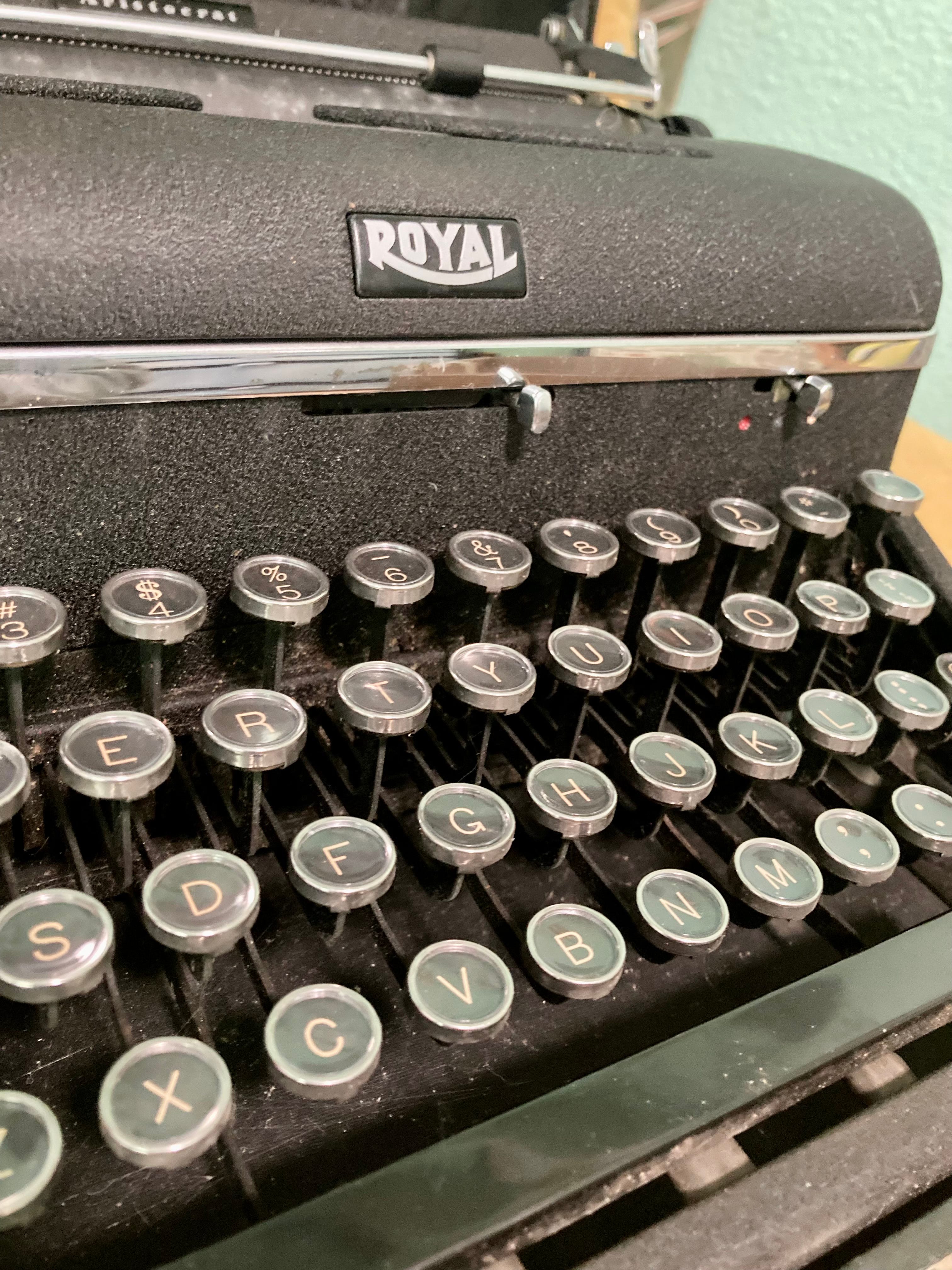
I have a typewriter. I haven’t used it in a long time- it needs a new ribbon. It’s also a Royal, the Royal Aristocrat. In my early twenties I would type on it when I was feeling particularly writerly, when I wanted a bit of noise and effort to accompany my writing. It was often gibberish, a stream of consciousness blather, as it wasn’t so much about the product as the act of typing, like a kid playing pretend.
Sliding a fresh piece of paper in and turning the knob the adjust the paper to the right spot, jabbing aggressively at the keys with my pointer fingers, sometimes missing the key and poking my finger into the space between. Watching the letters appear magically on the vacant whiteness, lined up in orderly rows. If I hit the wrong letter on accident I would backspace and cover it with an x. Then of course the ding! of getting to the end of the line, sliding the whole business over with the lever on the left. Reaching the end and pulling the paper out with a flourish.
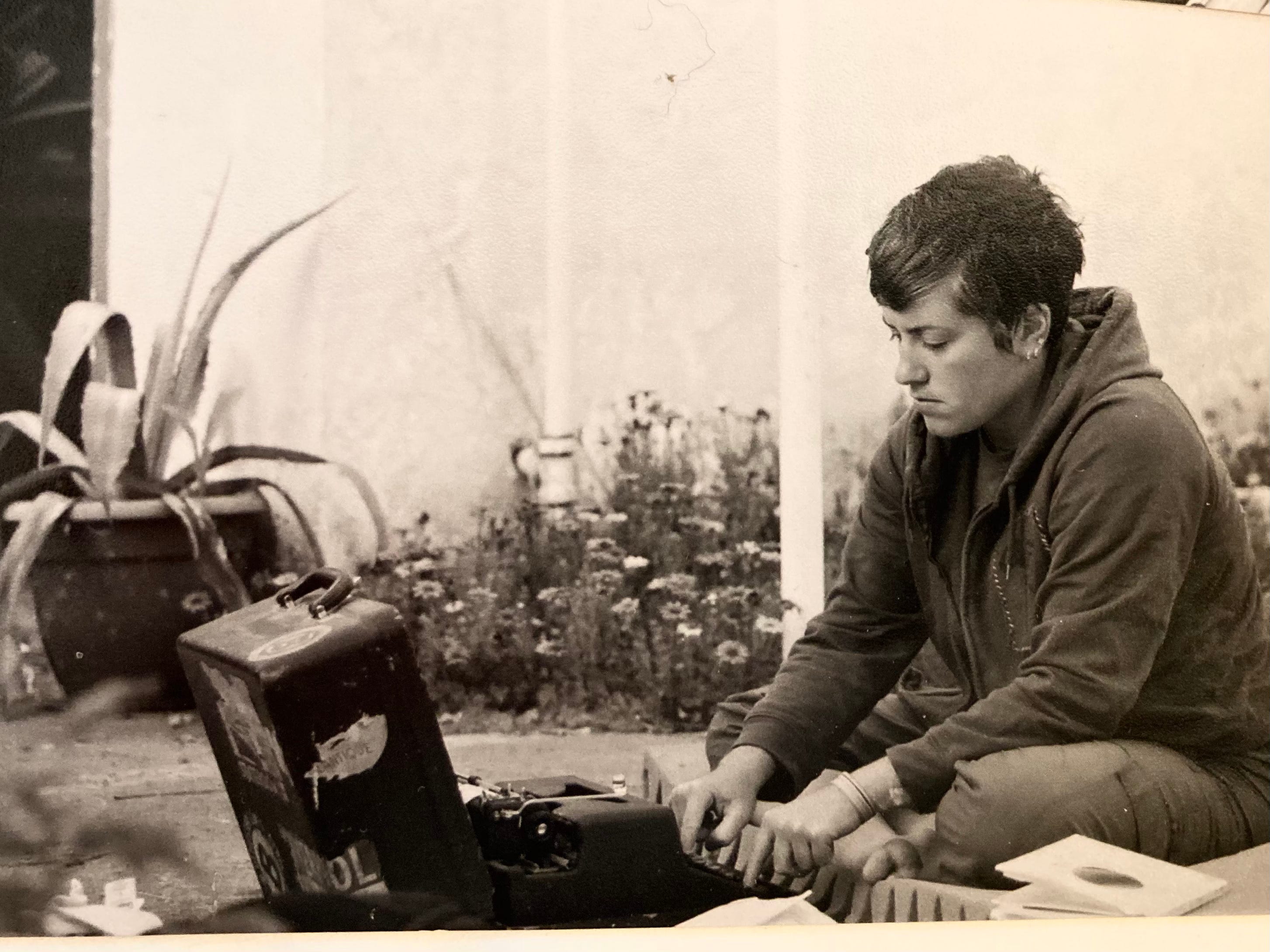
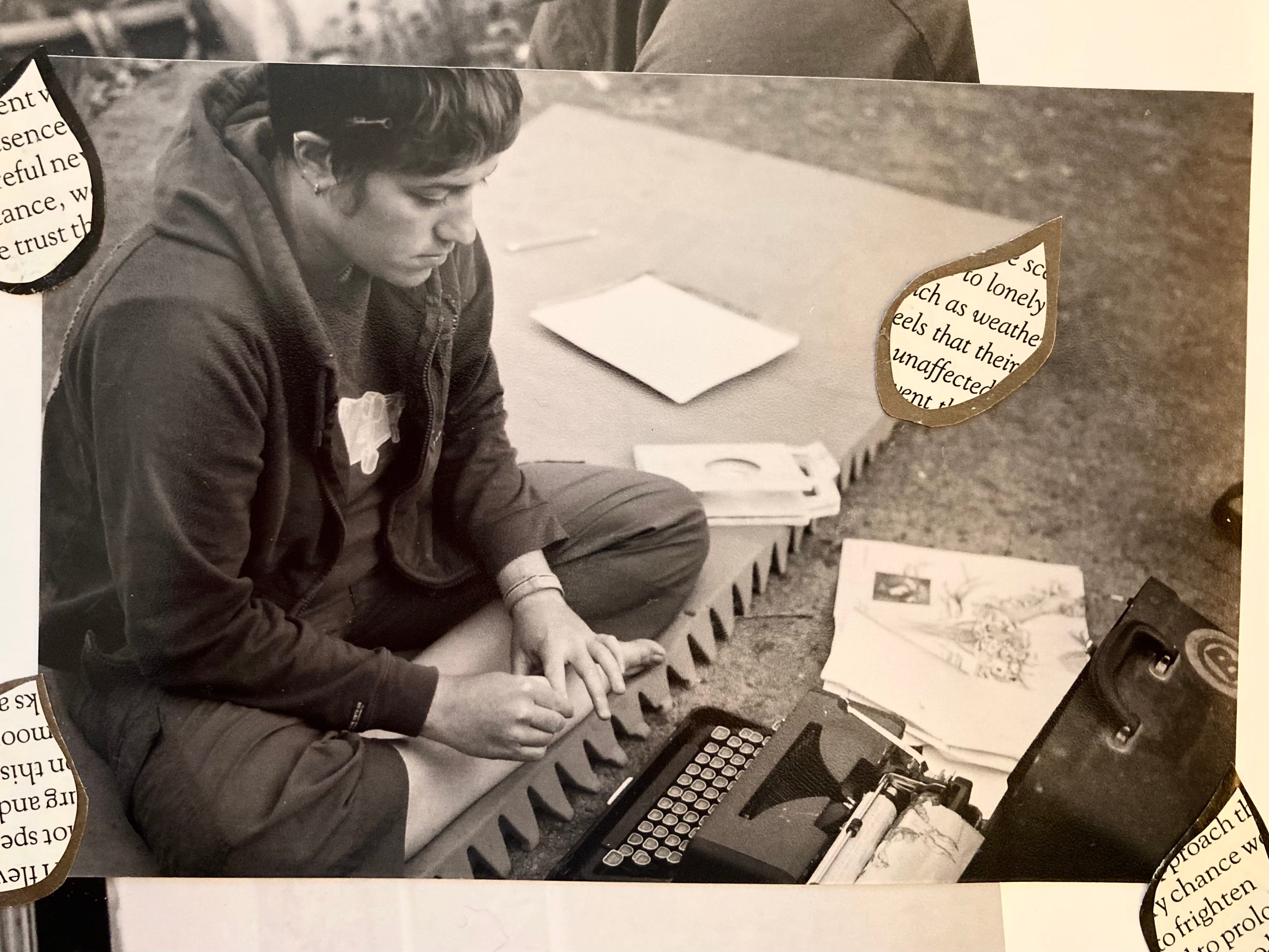
(Chico, CA circa 2003)
Something that I kept bumping up against when I was doing my 100 day poem challenge, was how to start. I wanted a template, a reliable process. A prompt, even. A way to tap into my poet brain. I never found one that I used consistently, which was maybe why it was so hard. Here’s another section of Story of a Poem, which I will keep in mind the next time I write a poem.
“You have been given the line, the image, the idea. Like a child or a new love, it is never what you expected. It wants you to change your life. You hear the line. It comes from somewhere. You’ve gathered, or maybe fathered, it. It comes to you or you to it. No one can tell you how it happens. Sometimes you write for a while, feeling nothing, until, almost unnoticed, something starts with mysterious life to glow.
“You feel yourself resist its strangeness. What does it mean? Is that what I meant to say? What do you do with it then? You cannot turn away.
“Make somewhere for it to live and belong. It is your job to imagine and invent that tree on which the treasured fruit could happily thrive. The strange treasure of a line, or image, or symbol, or word, or thought, or moment, needs the poem so that it can be more than itself in isolation, so that it can be truly perceived.
“Try to remember. The whole point of writing that first draft is just to hear the music, and then once you hear the music, you look for what could contain it. Reverse engineering. Farewell, old tree. Hello, something else, from which can hang the music you have found.
“Try to be quiet for once, to listen for something that you love. Let it come to you. Then build a structure in which what you love- a line, an image, a word- can exist; a situation, a scene, a sonnet, a ghazal, an ode, an abandoned palace, a happy graveyard, a breeze, a ghost ship’s wake, a map in winter, a rose factory, someone crossing the ocean in a fabulously unseaworthy craft, a marriage, a meal, a crucial childhood memory that never occurred, a radio being endlessly, impatiently turned, so on and so on and so on until the line can live there. You hear them. Then the poem can begin.”
AAAAAHHH!! So good, right??! I love this way of thinking about writing poetry. Make a place for your treasured image to live. Lovely.
I haven't been able to focus enough to read here with everything going on in MN. But I skimmed this, and my heart lifted when I saw the Royal. I have one. I also have a Hermes Rocket. Typewriter love forever.
"Listen for something that you love..." Well I sure do love those photos of you! Who took 'em? I think they loved you too...